
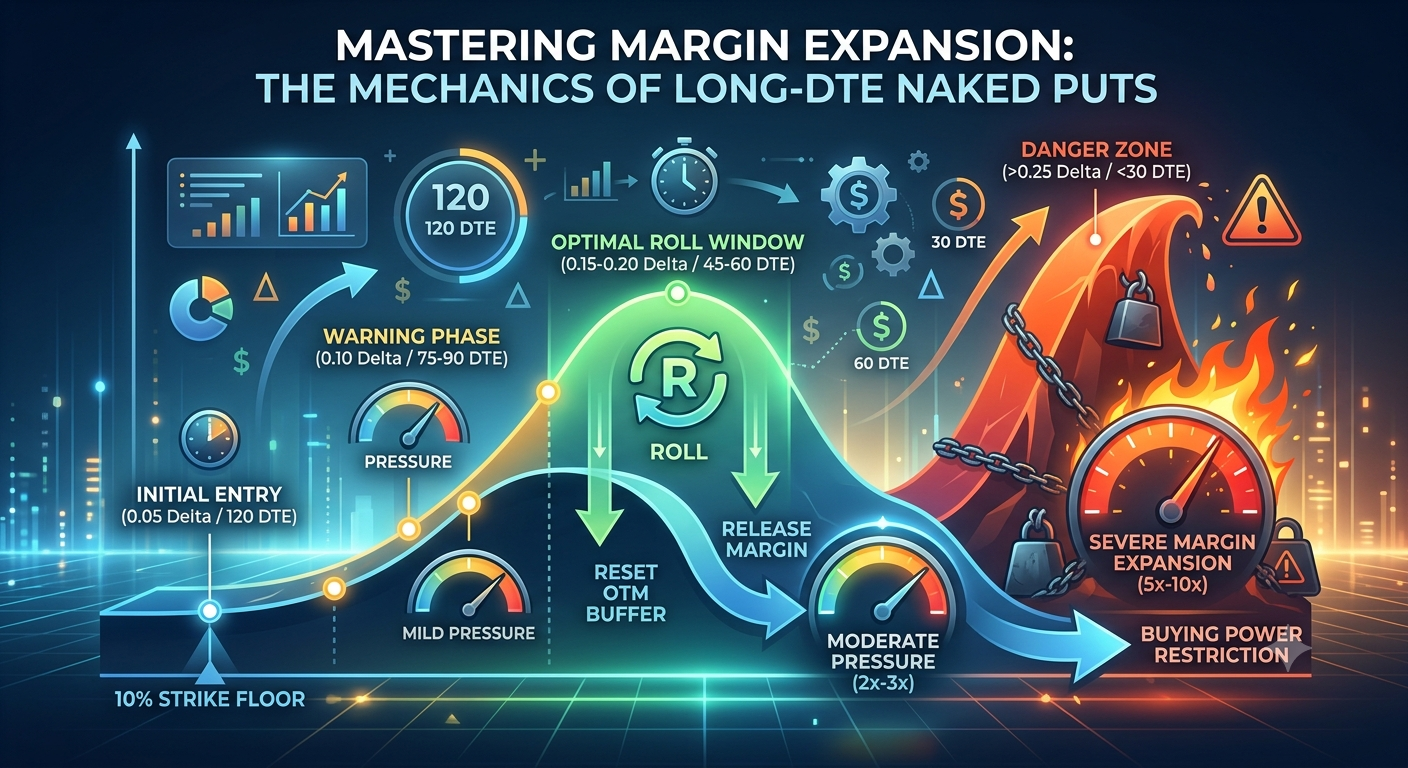
Initial Entry Phase
- Option Delta: 0.05
- Remaining DTE: 120 Days
- Margin Impact: Baseline Floor (~10% of strike price).
Action Protocol: Hold and monitor the position. At this stage, your out-of-the-money (OTM) cushion is large enough that the broker charges you the absolute minimum maintenance requirement.
Warning Phase
- Option Delta: 0.10 to 0.12
- Remaining DTE: 75 to 90 Days
- Margin Impact: Mild Expansion (~1.5x initial requirement).
Action Protocol: Set price targets and market alerts. The stock has moved toward your strike, shrinking your OTM cushion slightly, but the margin formula has not yet spiked non-linearly.
Optimal Roll Window
- Option Delta: 0.15 to 0.20
- Remaining DTE: 45 to 60 Days
- Margin Impact: Moderate
- Expansion (2x to 3x initial requirement).
Action Protocol: Roll Out and Down for a net credit. This is the ideal window to execute your roll. Gamma is still relatively low, and implied volatility (IV) hasn’t fully peak-expanded yet.
Rolling out extends your duration back to 120 DTE, while rolling down restores your OTM cushion, resetting your buying power requirement back down toward the 10% floor.
Critical Stress Zone
- Option Delta: Greater than 0.25
- Remaining DTE: Less than 30 Days
- Margin Impact: Severe Expansion (5x to 10x initial requirement).
Action Protocol: Reduce position size or convert to defined risk. In this zone, accelerating Gamma makes Delta shift rapidly per dollar drop in the stock, and IV spikes inflate the option’s ask price. The primary Reg T margin formula fully takes over, consuming massive amounts of buying power and making it difficult to roll down for a net credit.
Core Takeaway
The goal is to move before reaching the Critical Stress Zone. Executing your roll out and down during the Optimal Roll Window (0.15–0.20 Delta / 45–60 DTE) protects your available capital by preventing the broker’s primary margin formula from multiplying your buying power requirements.