
The semiconductor world was set abuzz when Elon Musk dropped a short post on X regarding the light source for TeraFab: “FEL FTW” (Free Electron Laser, For The Win).
The statement highlights a major structural shift in advanced chip manufacturing. Current Extreme Ultraviolet (EUV) lithography relies on Laser-Produced Plasma (LPP) light sources, which create light by firing high-power CO2 lasers at molten tin droplets. While functional, LPP systems are energy-intensive, generate tin debris that degrades optical mirrors, and face severe power limits.
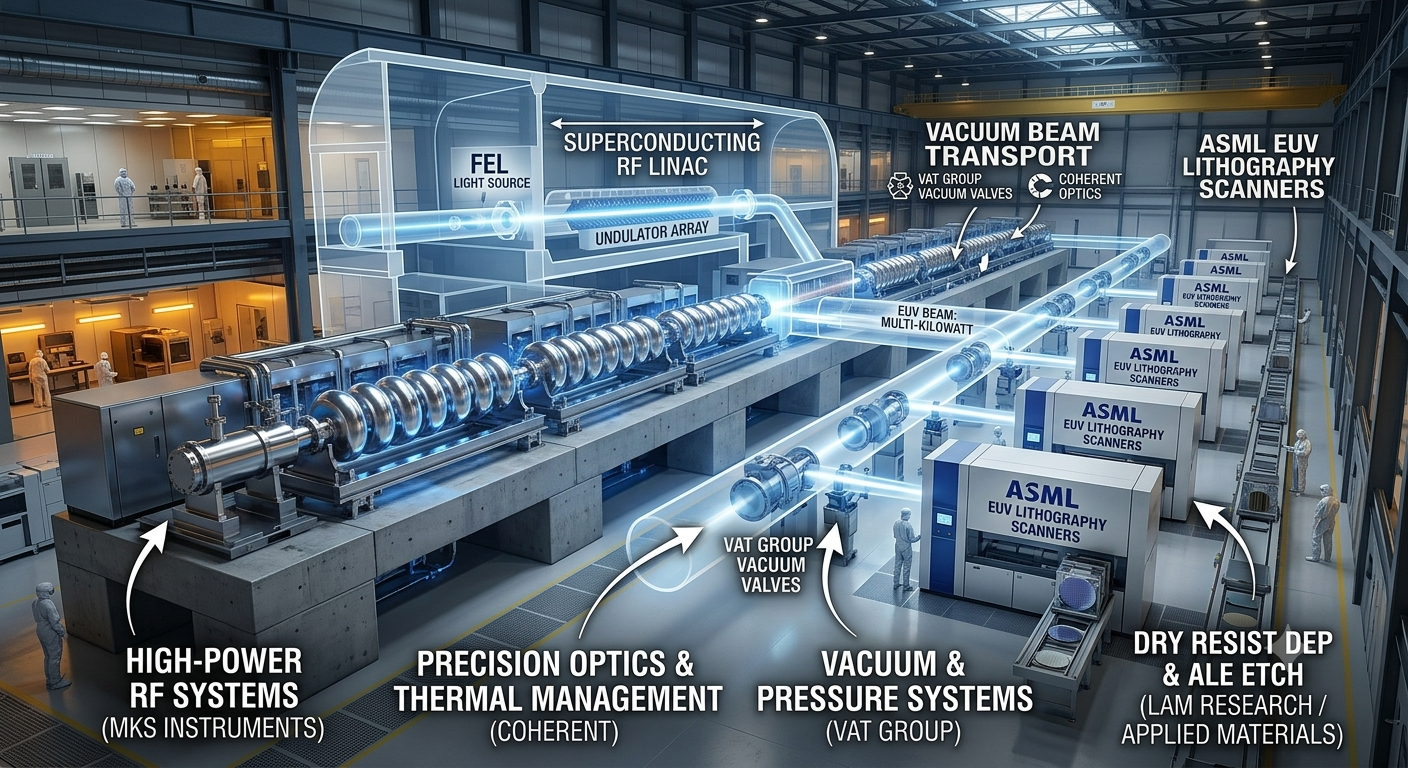
Free Electron Lasers fundamentally change this equation. By accelerating electron bunches to near-light speed in a linear accelerator and guiding them through undulator magnet arrays, an FEL generates clean, multi-kilowatt EUV light without tin debris or mechanical target wear. Instead of placing a separate, power-hungry laser inside every scanner tool, a single centralized FEL accelerator acts as a utility light plant, routing high-power EUV light across multiple lithography scanners simultaneously.
While pure-play FEL system developers remain private startups (like xLight) or government labs, public investors can gain targeted exposure through the critical suppliers manufacturing core accelerator components, optical beamlines, and advanced patterning tooling.
Key Publicly Traded Beneficiaries and Component Bottlenecks
ASML (NASDAQ: ASML) — The Lithography Integrator
Free Electron Lasers do not replace ASML; they replace the light source attached to ASML’s lithography scanners. Private startups building commercial FEL systems design their light output to feed directly into ASML’s high-precision tools.
Transitioning to an FEL gives ASML scanners access to multi-kilowatt power levels, unlocking faster wafer throughput, lower cost-per-wafer, and a clear operational roadmap toward sub-nanometer nodes.
Lam Research (NASDAQ: LRCX) — Patterning and Etching Bottlenecks
Higher EUV light intensity from an FEL allows fabs to use ultra-thin “dry resists” instead of traditional wet chemical photoresists. Lam Research leads the industry in specialized dry resist deposition and atomic-layer etch (ALE) tools tailored specifically for EUV patterning. Because ultra-bright FEL light changes how fine circuit features are exposed, TSMC and other fabs rely heavily on Lam’s etching and deposition tools to prevent pattern distortion at sub-2nm nodes.
Applied Materials (NASDAQ: AMAT) — Materials Engineering and Film Deposition
As EUV exposure yields denser circuit patterns, transferring those tiny features onto silicon requires atomic-level film deposition. Applied Materials supplies the high-precision chemical vapor deposition (CVD) and physical vapor deposition (PVD) systems needed to build hard masks and interconnect layers. Their tools ensure that the fine details printed by multi-kilowatt EUV light translate cleanly into working silicon layers without defect propagation.
Coherent (NYSE: COHR) — Precision Optics and Thermal Management
Multi-kilowatt FEL beams generate intense thermal energy along the light path. Coherent specializes in ultra-high damage threshold optics, silicon-carbide mirrors, and water-cooled beam-steering assemblies. Their hardware is essential for routing raw EUV light from a central particle accelerator into individual scanner chambers without melting or distorting optics.
MKS Instruments (NASDAQ: MKSI) — Radio-Frequency Power and Sub-Systems
At the heart of any linear accelerator is a Superconducting Radio-Frequency (SRF) linac. MKS Instruments manufactures high-power RF amplifiers, microwave generators, and precise power management systems. These sub-systems supply the energy required to accelerate electron bunches to relativistic speeds before they hit the undulator magnet arrays.
VAT Group (SWX: VACN) / Edwards — Ultra-High Vacuum (UHV) Systems
Electrons cannot travel at near-light speeds through ambient air; they require an ultra-high vacuum environment to avoid colliding with gas molecules. VAT Group holds a dominant global market share in advanced UHV isolation valves, making them an indispensable bottleneck supplier for the vacuum beamlines that make continuous-wave linear accelerators possible.
Carl Zeiss Group — Reflective Scanner Mirror Arrays
Once EUV light reaches the scanner tool, it must be reflected onto the silicon wafer using hyper-precise mirror assemblies. Carl Zeiss is the exclusive supplier of these optical mirror systems to ASML, ensuring they remain an irreplaceable bottleneck regardless of how light is generated at the source.
Taiwan Semiconductor Manufacturing Co. (NYSE: TSM) — The End-User Foundry
As the world’s leading chip fabricator, TSMC stands to benefit immensely from the operational efficiency of FEL technology. Replacing power-hungry LPP light sources with a centralized, energy-efficient FEL accelerator would drastically cut fab electricity bills, eliminate tin-debris downtime, and boost wafer output per hour.
Core Takeaway for Investors
Elon Musk’s public commitment to Free Electron Lasers highlights a broader industry push toward accelerator-driven manufacturing. While the core linear accelerators are developed by private startups or custom internal teams, the physical bottlenecks—high-power RF amplifiers (MKSI), beamline optics (COHR), vacuum hardware (VACN), scanner tools (ASML), and etch/deposition machinery (LRCX / AMAT)—remain firmly in the hands of established public semiconductor equipment giants.